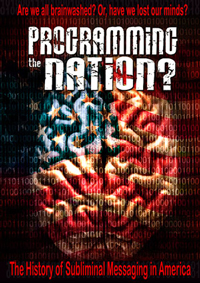
About the documentary film, "Programming the Nation?"

A new film about the media,
politics and pop-culture like
nothing you've ever seen - consciously

Click image below for Press Kit


poster


"PROGRAMMING THE NATION?" is a feature social documentary about the history of subliminal messaging in America. According to many authorities, since the late 1950's subliminal content has been tested and delivered through all forms of mass-media. Our modern military has even been accused of these practices in the War on Terror, against soldiers and civilians, both abroad and at home. Director,
Jeff Warrick, leads this journey through the subconscious mind while examining the reported history, scientific research and potential effects of such techniques on society. With eye-opening footage, revealing interviews, humorous anecdotes, and an array of visual effects, the film categorically explores the alleged usage of subliminals in advertising, music, film, television, anti-theft devices, political propaganda, military psychological operations, and advanced weapons development. As a result, Warrick makes it his personal mission to determine if these manipulative tactics have succeeded in "Programming the Nation?" Or, if subliminal programming belongs in the category of what many consider an urban legend? Now, you be the judge...

FILM OVERVIEW

The filmmakers have attempted to take a very objective, non-biased approach, by incorporating both sides of the argument on whether subliminal technology is actually being used, and to its effectiveness. The result is an often revealing, (and sometimes humorous), debate between interviewees with opposing viewpoints on a variety of topics. The documentary categorically explores, and is broken down into the following chapters:

Introduction

"Men are not prisoners of fate. But only prisoners of their own minds."- Franklin D. Roosevelt

Transmission is interrupted and static appears. We slowly transcend into the inner realm of the human brain and the opening credits. Neurons fire and photographs from early childhood to adulthood illustrate the Filmmaker's carefree life up to the turning point and catalyst for the investigation that follows - the events of Sept. 11, 2001.

The beginning of the personal narrative is one of questions and uncertainty: i.e. The "War on Terror", federal spending, George W. Bush, growing debt, Saddam Hussein, global warming, the economy, etc... Were we all being brainwashed?

With a background in advertising, the Filmmaker explains of his awareness of the "urban legends" surrounding "subliminal" messaging. But, how does Webster's define the word? Why did the network news and other forms of media, such as commercials, TV shows, and feature films seem to constantly hype and/or trivialize the topic? A MONTAGE OF EXAMPLES.

But, could such techniques really be contributing to a variety of social, political and economic problems currently present in our culture? Is it possible that subliminal messaging, and other subconscious techniques, have actually been "PROGRAMMING THE NATION?" Through the production of this documentary, the Filmmaker has decided to find out for himself. Now you be the judge...

The Subconscious Mind

This topic was originally theorized by the Greek Philosopher Aristotle. But, how does it work? What are Sigmund Freud's theories on the subconscious? What other hard evidence did researchers following Freud find to support his theories? Freud's Nephew, Edward Bernays, who used some of his Uncle's psychoanalytical theories, applied them to marketing, and wrote the book "Propaganda," is also discussed.

INTERVIEWS WITH: Wilson Bryan Key,
Dr. Eldon Taylor, August Bullock, and Douglas Rushkoff.


The James Vicary Experiment

In 1957, a marketing researcher named James Vicary announced that he had conducted an experiment in a New Jersey movie theater where he had flashed the words "Hungry? Eat Popcorn" and "Drink Coca-Cola" during the movie "PICNIC" at very fast rates and substantially increased popcorn and coke sales. Did this really happen? Was it successful? The Director asks several people and gets a variety of responses. Particularly when he goes out and speaks with average citizens on the street.

The Filmmaker's personal narrative illustrates that his own Father had read Wilson Bryan Key's "Subliminal Seduction" in the 1970's - which successfully popularized the Vicary Experiment for an entire new generation of Americans, (himself included), over a decade after the original incident.

Following Vicary's press conference about his experiment in 1957, a number of companies, radio broadcasters and television stations admitted that they were experimenting with these tactics and it caused a public outrage. Eventually, Congress decided they would have to hold hearings on this and asked Vicary to come to Washington to demonstrate his subliminal process.

The Networks decided they would form the National Association of Broadcasters, (NAB), to keep Congress from acting and claimed that subliminal advertising didn't work. In 1962, Vicary admitted that he had exaggerated the length and results of his original experiment.

Unfortunately, as the Filmmaker points out, Wilson Bryan Key never mentions this info in his 1973 bestseller, "Subliminal Seduction" - but rather continues to popularize the story and overall results. To this day, no one really knows for certain if The Vicary Experiment even happened at all.

INTERVIEWS WITH: William Poundstone, August Bullock, Wilson Bryan Key, and Dr. Eldon Taylor.


Subliminal Research

Interview participants discuss the variety of equipment that Motivational Researcher's developed after the 1950's to measure people's unconscious reactions. The Filmmaker, having explored hundreds of research studies in scientific journals, finds that most of them successfully prove the mind's ability to register subliminal perception. But, what about their effects?

A closer look at a number of research studies including The B.W. Levinson experiment in 1960, the Kilbourne experiment in the mid-1980's, and Dr. Howard Shevrin's more recent findings in this area. According to one expert, new techniques like PET Scans, MRI's and other equipment can actually show the precise areas of the brain that are excited by subliminal stimulation.

Nevertheless, the question that still remains is, "can a subliminal stimuli cause a person's behavior to change?"

INTERVIEWS WITH: August Bullock,
Dr. Eldon Taylor, Dr. Howard Shevrin.


Subliminal Rock N Roll

The personal narrative reveals that as a teenager in the 1980's, the Filmmaker's Church Youth Pastor often lectured on how subliminal messages and backward masking in rock music was responsible for causing people to take drugs, worship Satan, and commit suicide.

Allegedly, it all started with The Beatles, and while the Fab Four were definitely innovators of contemporary music during the 1960's, did they really add subliminal messages such as "I buried Paul" at the end of Strawberry Fields Forever? Or, "turn me on dead man" on Revolution 9 from the White Album when played in reverse?

The most notorious example of a subliminal found in rock music, is arguably the alleged back-masked Satanic messages on Led Zeppelin's "Stairway to Heaven," during a section of the song when played backwards. Many religious, conservative and parental groups during the 70's and 80's, quickly attributed this to the band's interest in Eastern Mysticism and/or Jimmy Page's fascination with the occult. These critics argued that the band in some way knew about the insertion of such messages. Interviews with both sides, including the religious right and those involved with the actual recording, debate this issue.

Due to conflicting viewpoints, The Director decides to conduct his own mini-experiment with a handful of high-school students who were unfamiliar with the accusatory messages in the song. He divides them into three groups, and discovers that the two groups who were primed and told they would hear certain hidden messages, when asked, all agreed that they heard the messages presented to them. The third group was not primed or given a stated message in advance, and when asked to describe what they heard, not one reported hearing any messages. So, does this prove that its actually a case of "people will hear whatever they are told or want to hear?"

INTERVIEWS WITH: David Fricke, William Poundstone, Geoff Tate, Pastor Joe Schimmel, Andy Johns, and Mark Mothersbaugh.

The Judas Priest Trial

In 1985, two Reno, NV teenagers attempted suicide after claiming to have listened to the song, "Better By You, Better Than Me", off the Staind Class album by heavy metal rock band Judas Priest. In 1990, after a Nevada Judge determined that subliminal messages allegedly found in the song would not be afforded First Amendment protection, the wrongful death case against the band and CBS Records went to trial. Expert witnesses who testified on behalf of the plaintiffs and the defense give their details and the outcome of this landmark and shocking court case.

INTERVIEWS WITH: Dr. Eldon Taylor, Suellen Fulstone, Dr. Howard Shevrin, and Pastor Joe Schimmel, with archival news footage and archival interviews with the surviving teenager, James Vance, and Rob Halford, lead singer of Judas Priest.

Subliminals and Film

Alfred Hitchcock is considered by many to be one of the first feature Hollywood film directors to use subliminal editing techniques in films such as Spellbound, (1945), and Psycho, (1960). Should sound design techniques used in Francis Ford Coppola's Apocalypse Now, (1979), and countless other Hollywood films be considered "subliminal"? What about flashed images such as those in William Friedkin's The Exorcist, (1973), David Fincher's Se7en, (1995), and Fight Club, (1999), or hidden sexual imagery such as that allegedly found in numerous examples of Disney Animation? According to experts, the most effective form of subliminal advertising is actually the use of product placement in film and television.

INTERVIEWS WITH: William Poundstone, Hilton A. Green, Christopher Coppola, and Richard Beggs, with archival news footage and various clips from an assortment of examined films.

The Science of Consumption

How does advertising really effect us? Does it actually create anxiety and neurosis, or make women feel bad about themselves? Is it possibly responsible for things like anorexia and bulimia? How does advertising effect children and should all advertising directed toward them be considered subliminal? Has advertising created the cognitive drive of "MORE" in our modern society? Why are people maxed out today and credit card debt so high? What role has advertising played in this?

INTERVIEWS WITH: Jerry Mander, Douglas Rushkoff, August Bullock, Bill Yousman, Geoff Tate, Wilson Bryan Key, Dr. Eldon Taylor, Pastor Joe Schimmel, Noam Chomsky, Mark Crispin Miller, Ann Simonton, and Dennis Kucinich.

Subliminal Advertising

How does subliminal advertising work? Experts show numerous examples of subliminals in advertising - generally sexually related to stimulate sexual anxiety. Also, examples of sexual violence in advertising and how this reinforces gender biases in society.

But, what does the average American think about subliminal advertising? According to a 1992 study, 57% of those asked said they believe "subliminal advertising happens" and only 1 in 12 thought "it almost never happens." The Filmmaker goes to the streets of Times Square to do his own mini-survey and see what people think today.

An interviewee who has actually worked in advertising for a number of years creating jingles and background music, actually admits to inserting subliminal audio messages into numerous commercials that he's worked on. The Filmmaker tries contacting NY Ad Agencies to see what they have to say about this, but gets no response, and not one person agrees to meet with him on camera to discuss this.

According to experts, there are currently no laws that prohibit the use of subliminal advertising. The Director contacts the FCC, who send him a letter referencing a 1972 policy statement regarding the issue. The Director also examines a 1984 Congressional Hearing that took place regarding the use and potential prohibitions to be placed on subliminal advertising.

The Filmmaker contacts the American Association of Advertising Agencies, (AAAA), who refuse to meet with him. So, during one of the production teams visits to New York City, he attempts to get inside and speak with someone from the Agency in the Chrystler Building - finally confronting the VP of Public Affairs at AAAA.

The final question raised in this chapter, is whether some borderline individuals are being pushed over the edge because of the effects of subliminal advertising?

INTERVIEWS WITH: August Bullock, Wilson Bryan Key, Douglas Rushkoff, Dr. Howard Shevrin, Mark Crispin Miller, and Mark Mothersbaugh, with archival news footage, subliminal ad montages, on the street interviews, and hidden camera footage.


 The Black Box

In 1979, a Time Magazine article was written about a subliminal anti-theft device called The Black Box, and an interview was conducted with the inventor, Hal C. Becker. Are such devices still being used today by large corporate retailers? Are they successful? What other effects might they have?

INTERVIEWS WITH: Dr. Eldon Taylor and Howard Shevrin, with archival news and additional footage.

Subliminal Politics

In what way might our government be using subliminal techniques? Experts discuss the Republican National Committee's infamous "RATS" Ad used during the 2000 Presidential Election to promote George W. Bush. A study conducted at the Hebrew University in Jerusalem using subliminal flashes is also examined in relation to political elections.

Experts also examine Video News Releases, (VNR's) used by Government Agencies and large corporations. These are essentially paid press releases that look like news reports, and are given to local and national TV stations for eventual broadcast as part of their news shows – with no disclosure to the public regarding who actually produced them.


The use of fear, such as terrorist threat levels, and other propaganda tactics used in the build up to the "War on Terror" to sell the war to the US population, is also explored.

INTERVIEWS WITH: August Bullock, William Poundstone, Noam Chomsky, Bill Yousman, Amy Goodman, Douglas Rushkoff, Mark Crispin Miller, Geoff Tate, Dennis Kucinich and Diane E. Watson, with archival news and additional footage, including interviews with George W. Bush, Al Gore and others.

Psychological Operations

An actual part of the US Army's Special Operations Units that focuses on psychological tactics used against both civilians and soldiers during conflict. Experts explain the specific techniques, many of which are considered "subliminal", and their affects on both foreign nations and the American public.

Also examined are radio transmissions from C-130 aircraft and television broadcasts with hidden messages used to heighten fear levels in large populations. Do such techniques work? Are they being used on Americans? What about the Waco, Tx. siege in 1993 between the ATF / FBI and David Koresh / the Branch Davidians? What kind of "subliminal" PSY OPS tactics were used during this standoff?

INTERVIEWS WITH: Mark Crispin Miller, Dr. Eldon Taylor, John B. Alexander, Amy Goodman, and Dr. Nick Begich, with archival news and additional footage.

Project HAARP

The High-Frequency Active Auroral Research Program in Alaska. What is it? How is it used? What kind of affects does it have on the environment and atmosphere? Can it be used to influence the minds of large areas of the population using "subliminal" techniques? Or, is this just another "conspiracy theory"?

INTERVIEWS WITH: Dr. Nick Begich and John B. Alexander.


Conclusion

While attempting to remain objective, the Filmmaker has reached the conclusion that its no longer a questions of "if", but rather "to what extent", the government, pop-culture, and advertisers have really succeeded in "Programming the Nation." But, how far could it go if left unregulated and undisclosed? If this is true, then "denial" certainly isn't the solution. What can we do?


The Filmmaker and experts offer the following solutions: media literacy and continued education. "Tune out" and "turn off," until practices change. Raise our level of consciousness, so that its no longer "subliminal". Come together with our families and discuss these issues. Come together with our communities, to further discuss these, and other issues. If enough of us come together and think collectively in a positive direction, we can overcome and achieve anything!

INTERVIEWS WITH: Douglas Rushkoff, Geoff Tate, August Bullock, Dennis Kucinich, Dr. Nick Begich, and Dr. Eldon Taylor, with archival news, feature film, television and additional footage.